05 / ODS DUAL ALIGNER SYSTEMOur Technology Why Dual Aligners Matter
A treatment-stage approach to aligner material selection, guided by the treating doctor.
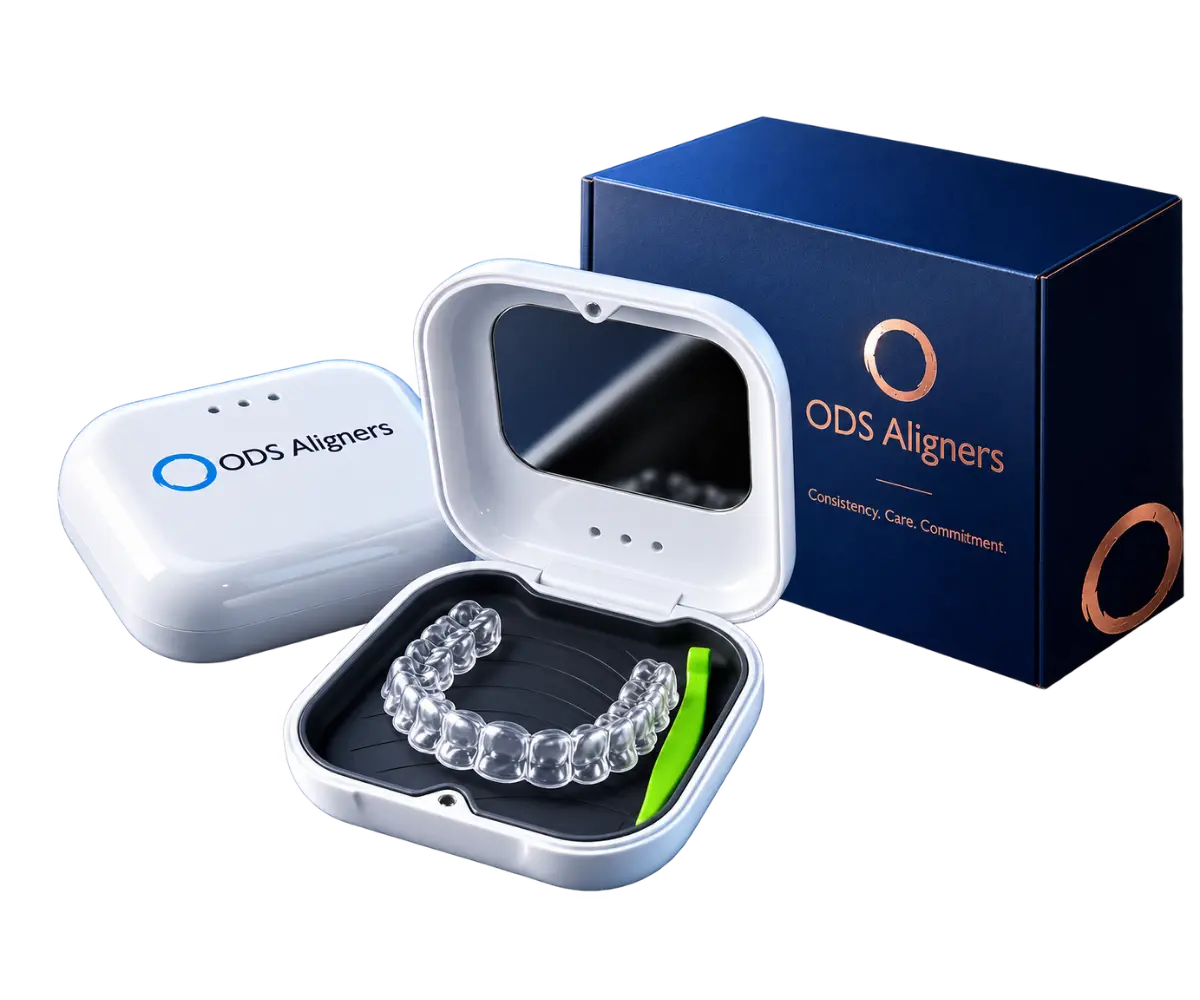
An aligner is more than a tray that fits over the teeth. Its material influences flexibility, stiffness, force delivery and how those forces change during wear.
Laboratory research indicates that material composition and thickness affect the forces produced and distributed by clear aligners. Material relaxation during use is also important when selecting an appliance and wear protocol. These findings concern aligner biomechanics in general, rather than proven clinical outcomes of the ODS Dual Aligner System.1, 2
One Treatment. Different Material Requirements.
Different stages of orthodontic treatment can call for different force characteristics. Material choice should therefore follow the planned tooth movement, aligner design, attachments or other auxiliaries, prescribed wear interval and the patient's clinical response. A material change is a treatment-planning decision, not an automatic way to improve results.
ODS Premium Aligners: Co-PU Composite Material
ODS Premium Aligners use a Co-PU composite material. Its relevant characteristics, including stiffness, flexibility, shape recovery and force retention, need to be considered alongside aligner thickness and design. Within an ODS treatment protocol, Premium Aligners provide one material option that the treating doctor may select when its characteristics are suitable for the movement being planned.
The decision to use Premium at a particular stage should follow the clinician's assessment of the case and the approved digital set-up. The available general studies do not establish that ODS Premium produces a specific clinical benefit over another ODS material. Product-specific test data would be needed for such a comparison.
ODS FLX Aligners: Multilayer Material
ODS FLX Aligners use a multilayer material construction. Combining different material layers allows complementary mechanical properties to be engineered within the same aligner, offering greater versatility in flexibility, resilience and force response.. However, the direction and size of those differences depend on the exact layers, thickness and manufacturing conditions.
FLX may be considered where its measured mechanical characteristics suit the intended movement or stage of treatment. The treating doctor should make that selection based on case requirements, staging and any supporting mechanics. Multilayer construction alone does not demonstrate greater comfort, faster movement or a superior clinical outcome.
How Material Selection Fits the ODS Dual Aligner System
The ODS approach allows the treating doctor to consider different aligner materials at different stages where clinically appropriate. The purpose is to match material characteristics to treatment requirements, rather than to switch materials routinely or assume that two materials are always better than one.
The treating doctor remains responsible for diagnosis, movement objectives, treatment staging, selecting and approving the plan, and monitoring the clinical response.
How ODS Uses This Principle
With ODS, material selection becomes part of the treatment strategy:
What the Evidence Supports
Published laboratory studies highlight the influence of material composition and thickness on force generation, distribution and decay in clear aligners. A 2024 in-vitro study compared several commercially available single-layer and multilayer materials and found differences in force generation and distribution; the authors noted that a proposed exchangeable-material protocol still needs clinical testing.1 Separate laboratory work documents force decay in PET-G specimens under simulated wear conditions.2
Evidence limitation: These publications do not directly evaluate the ODS Premium and FLX combination or demonstrate that switching between them improves treatment speed, predictability or patient outcomes. ODS-specific material testing and clinical studies would be required to support those claims.
Research References
- Elshazly TM et al. (2024). Effect of material composition and thickness of orthodontic aligners on the transmission and distribution of forces: an in vitro study. Clinical Oral Investigations. Read the published study.
- Force decay of polyethylene terephthalate glycol aligner materials during simulation of typical clinical loading/unloading scenarios. (2021). Read the published study.
Material selection should follow clinical requirements, not a one-material-fits-all assumption.